Fourteen U.S. billion-dollar weather disasters in 2011: a new record
It's time to add another billion-dollar weather disaster to the growing 2011 total of these costly disasters: the extraordinary early-season Northeast U.S. snowstorm of October 29, which dumped up to 32 inches of snow, brought winds gusts of 70 mph to the coast, and killed at least 22 people. Not since the infamous snow hurricane of 1804 have such prodigious amounts of October snow been recorded in New England and, to a lesser extent, in the mid-Atlantic states. Trees that had not yet lost their leaves suffered tremendous damage from the wet, heavy snow. Snapped branches and falling trees brought down numerous power lines, leaving at least 3 million people without electricity. The damage estimate in Connecticut alone is $3 billion, far more than the damage Hurricane Irene did to the state. Hundreds of thousands still remain without power a week after the storm, with full electricity not expected to be restored until Monday.

Figure 1. Wet, heavy snow from the October 29, 2011 snowstorm weighing down trees still sporting their fall leaves in Winchester, VA. Image credit: wunderphotographer MaddScientist98.
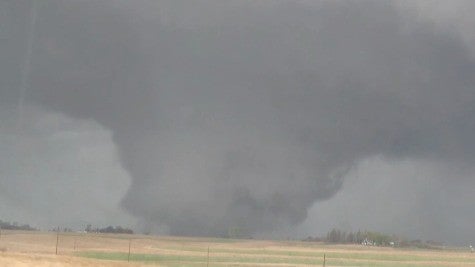
The October 29 snow storm brings the 2011 tally of U.S. billion-dollar weather disasters to fourteen, thoroughly smashing the previous record of nine such disasters, set in 2008. Between 1980 - 2010, the U.S. averaged 3.5 of these weather disasters per year. Through August, the National Climatic Data Center (NCDC) estimated that ten weather disasters costing at least $1 billion had hit the U.S., at total cost of up to $45 billion. However, the October 29 snow storm brings us up to eleven billion-dollar disasters, and a new disaster analysis done by global reinsurance company AON Benfield adds three more. Flood damage from the remnants of Tropical Storm Lee in the Northeast on September 8 is now estimated at more than $1 billion, and two outbreaks of severe thunderstorms and tornadoes--one in April and one in June--now have damage estimates exceeding $1 billion. A remarkable seven severe thunderstorm/tornado outbreaks did more than $1 billion each in damage in 2011, and an eighth outbreak July 10 - 14 came close, with damages of $900 million. In total, the fourteen billion-dollar disasters killed 675 people. Tornadoes, hurricanes, and floods in these fourteen disasters killed over 600 people, putting 2011 into fourth place since 1940 for most deaths by severe storms. Only 2005, with over 1,000 deaths caused by Katrina, 1969, with over 700 hurricane and flood-related deaths, and 1972, with 676 hurricane and flood-related deaths, were deadlier years for storms, according to NOAA. The fourteen billion-dollar weather disasters of 2011 caused $53 billion in damage, putting 2011 in fifth place for most damages from billion-dollar weather disasters. The top damage years, according to NCDC in adjusted 2011 dollars, were 2005 (the year of Hurricanes Katrina, Rita and Wilma), 2008 (Hurricane Ike), 1988 (Midwest drought), and 1980 (Midwest drought). With nearly two months remaining in 2011, the potential exists for more billion-dollar weather disasters this year. Our first opportunity comes Tuesday, when the NOAA Storm Prediction Center is forecasting the possibility of a severe weather outbreak centered over Arkansas and Missouri.
Video 1. Remarkable video of the tornado that hit Tuscaloosa, Alabama during the April 25 - 30, 2011 Super Outbreak. This tornado outbreak was the most expensive U.S. weather-related disaster of 2011, with damages estimated at $9 billion. Fast forward to minute four to see the worst of the storm.
Here are AON Benfield's estimates of the damages and NCDC's estimates of the death tolls from 2011's fourteen billion-dollar weather disasters (a clickable version of this table with information on each disaster is available on our severe weather resource page):

Have a great weekend, everyone, and I'll be back with a new post on Monday.
Angela Fritz is subbing for Ricky Rood this week, and has written an interesting post on the latest climate change controversy, the release of the new Berkeley Earth Surface Temperature (BEST) study by skeptic Dr. Richard Muller.
Jeff Masters
Reader Comments
Page: 1 | 2 | 3 | 4 | 5 | 6 | 7 | 8 | 9 | 10 | 11 | 12 | 13 — Blog Index
Its the area of rivers and bays that are affected by the tides.
Did it in 13.
Did you ever consider writing tropical updates for the NHC? LOL
no, but that would be one gigantic volcano...
hahaha you dont like wordiness?
LOL! .... and he DID IT too!
easy peasy ;)
A BP refinery? -------> exit, stage right!
hahahaha, idk what it is, very weird though
Just called me the attention that everything else moves but that plume looks stationary....
the source looks very stationary...
No!
Night!
Odd looking on radar there. Some very stationary ground clutter or something.
yeah but on sat it looks like a single source, if it were the mountains wouldn't it be more of a sheet?
Perhaps not perfect in a tradional sense, but the structure of wilma at peak still amazes me.
Magnitude 4.7
Date-Time
Saturday, November 05, 2011 at 07:12:45 UTC
Saturday, November 05, 2011 at 02:12:45 AM at epicenter
Time of Earthquake in other Time Zones
Location 35.570%uFFFDN, 96.703%uFFFDW
Depth 4.9 km (3.0 miles)
Region OKLAHOMA
Distances 33 km (20 miles) NE of Shawnee, Oklahoma
67 km (41 miles) W of Okmulgee, Oklahoma
68 km (42 miles) SSE of Stillwater, Oklahoma
75 km (46 miles) E of OKLAHOMA CITY, Oklahoma
Location Uncertainty horizontal /- 12.9 km (8.0 miles); depth /- 3 km (1.9 miles)
Parameters NST=240, Nph=246, Dmin=90.2 km, Rmss=1.31 sec, Gp= 18%uFFFD,
M-type=body wave magnitude (Mb), Version=9
Source
Magnitude: USGS NEIC (WDCS-D)
Location: USGS NEIC (WDCS-D)
Event ID usb0006k8b
* - From the report's conclusion: "The strong spatial and temporal correlations to the hydraulic-fracturing in Picket Unit B Well 4-18 certainly suggests that the earthquakes observed in the Eola Field could have possibly been triggered by this activity."
Link
Sad, he lived a good life.
:(
DRY SLOTTING ALOFT STILL LOOKS LIKELY...SO WILL
CONTINUE TO UNDERCUT STORM POTENTIAL OVER SOUTH CENTRAL TX...WITH
THE BEST POTENTIAL OVER THE HILL COUNTRY AND EASTERN COUNTIES
MONDAY NIGHT AND EARLY TUESDAY. THUS A MOSTLY DRY FRONT IS
EXPECTED OVER SOUTH CENTRAL TEXAS AS THE SECOND UPPER LOW EJECTS
NORTH OF SOUTH CENTRAL TX
$
I hope we don't see one of these this Cyclone season.
Impressive images. If you want to post these and more hurricane and typhoon images,I made a blog to post them.
Link
A zone of dry (and relatively cloud-free) air which wraps west- or south-westwards into the southern and eastern parts of a synoptic scale or mesoscale low pressure system. A dry slot is seen best on satellite photographs. A dry slot should not be confused with clear slot, which is a storm-scale phenomenon.
I have no earthly idea whether the fracing has any correlation with the quakes but, C'mon - "could have possibly been" does not equate to likely.
And, FYI, there is a huge difference in magnitude between a 4.7 and a 5.5. I may be way off on the math here, but I think a 5.5 is something like 80 times greater magnitude than a 4.7.
Anyone who's been tracking long enough should be easily able to see which one is her real eye. And yet, despite the very well defined eye, she was only a 90mph category 1 hurricane at the time of that picture.
This may have not had a landfall, but it was sure pretty,
Hurricane Isaac (Cat 4) at peak
(and its not the strongest either, but it was a beauty)
I'll go with that. Interesting algebra you are developing there.
This reminds me of how difficult it is to grasp how large a big number is--or how big a large number is. Once I get past two they all seem many to me. Wikipedia to the rescue.
"The expression Richter magnitude scale refers to a number of ways to assign a single number to quantify the energy contained in an earthquake.
"In all cases, the magnitude is a base-10 logarithmic scale obtained by calculating the logarithm of the amplitude of waves measured by a seismograph. An earthquake that measures 5.0 on the Richter scale has a shaking amplitude 10 times larger and corresponds to an energy release of √1000 ≈ 31.6 times greater than one that measures 4.0."
Then there is also this interesting passage.
"The Richter scale proper was defined in 1935 for particular circumstances and instruments; the instrument used saturated for strong earthquakes. The scale was replaced by the moment magnitude scale (MMS); for earthquakes adequately measured by the Richter scale, numerical values are approximately the same. Although values measured for earthquakes now are actually Mw (MMS), they are frequently reported as Richter values, even for earthquakes of magnitude over 8, where the Richter scale becomes meaningless.
"The Richter and MMS scales measure the energy released by an earthquake; another scale, the Mercalli intensity scale, classifies earthquakes by their effects, from detectable by instruments but not noticeable to catastrophic. The energy and effects are not necessarily strongly correlated; a shallow earthquake in a populated area with soil of certain types can be far more intense than a much more energetic deep earthquake in an isolated area."
Reminds me of the options available for measuring the intensity of tropical storms. The effects are not necessarily commensurate with the barometric pressure or wind speed. Then again, as Irene showed, the wind speed is not necessarily commensurate with barometric pressure. Complicated world.
Just saw this news story about air conditioning technology. Salt-driven air conditioner. They use a dessicant to remove water from the air.
Viewing: 201 - 251
Page: 1 | 2 | 3 | 4 | 5 | 6 | 7 | 8 | 9 | 10 | 11 | 12 | 13 — Blog Index